

Selecting courses for account managers is essential for cultivating the skills required to forge robust client relationships and stimulate revenue growth. This article underscores best practices, including:
Such an approach ensures that account managers select programs that not only meet their specific needs but also adapt to the evolving demands of the industry.
In an increasingly competitive business environment, the significance of account management training is paramount. Organizations striving to build and maintain strong client relationships must equip account managers with essential skills.
Comprehensive training programs, such as those offered by Pods Asia, provide professionals with the necessary tools to:
Evidence shows that companies investing in such training experience notable revenue growth, underscoring the critical focus on tailored approaches in account management.
As client expectations evolve, understanding the diverse types of training available, the essential skills required, and best practices for selecting courses becomes vital for professionals aiming to excel in their roles and drive organizational success.
Education through courses for account managers is essential for equipping professionals with the skills necessary to cultivate and sustain robust client relationships. Comprehensive development initiatives, such as those offered by Pods Asia, encompass courses that empower account managers to adeptly identify client needs, navigate complex sales processes, and enhance customer satisfaction. Evidence demonstrates that organizations investing in courses for account managers enjoy substantial benefits, including a direct correlation with revenue growth; companies that expand more swiftly derive 40% more of their revenue from personalization than their slower-growing counterparts, underscoring the critical nature of tailored approaches in account management.
Furthermore, Pods Asia's proven sales transformation strategies have yielded remarkable outcomes, achieving 28% revenue growth through customized go-to-market (GTM) solutions and sales-as-a-service offerings specifically designed for engineering services. A compelling case study illustrates how the application of these strategies enabled an engineering services company to capture a 5% market share against global cloud providers, showcasing the effectiveness of Pods Asia's instruction. Additionally, testimonials from participants highlight the practical benefits and real-world applications of the program, reinforcing its value.
Organizations prioritizing client service training, such as courses for account managers, not only enhance customer retention rates but also catalyze significant revenue growth, rendering such training indispensable for sustained success in sales roles. As the landscape of customer expectations evolves, the importance of ongoing education—particularly through courses for account managers—in client management becomes increasingly clear. A case study titled 'What Role Does Continuous Education Play in Leadership Development?' illustrates that investing in continuous education empowers leaders to drive innovation, foster a positive work culture, and exemplify best practices for their teams, thus contributing to overall organizational success. This positions trained professionals as pivotal drivers of organizational achievement, particularly in competitive markets where effective deal-making is essential for capturing market share.

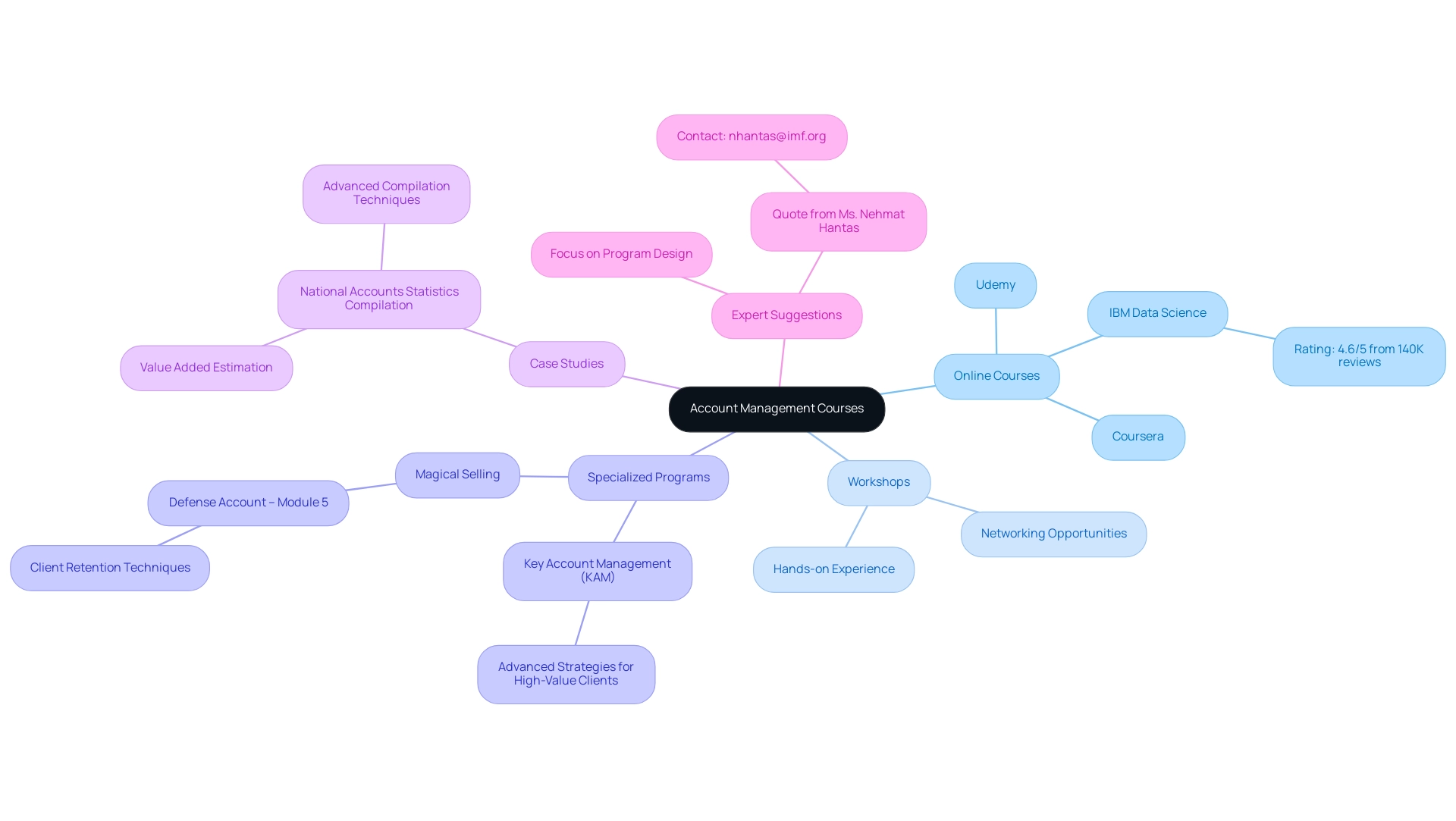
A diverse array of formats is available for courses tailored for account managers, catering to the varied needs of professionals in the field. Online platforms such as Coursera and Udemy have surged in popularity due to their flexible learning options, empowering busy managers to access high-quality content at their convenience. For instance, IBM Data Science boasts an impressive rating of 4.6 out of 5 stars from 140K reviews, underscoring the effectiveness of online courses in this domain.
Statistics from 2025 reveal a significant uptick in enrollment for courses designed for account managers, with many online offerings receiving ratings exceeding 4.5 stars from thousands of participants. This reflects their effectiveness and relevance in today’s competitive market.
In addition to online offerings, workshops and in-person sessions provide invaluable hands-on experience and networking opportunities, crucial for skill development. Specialized programs, such as Key Account Management (KAM) courses, concentrate on advanced strategies for managing high-value clients, equipping professionals with essential tools to nurture long-term relationships and drive revenue growth.
Furthermore, Magical Selling’s educational programs emphasize the importance of strategic client oversight strategies, particularly regarding the Defense Account – Module 5, which outlines a comprehensive plan to retain and expand clients. This equips sales teams with techniques designed to enhance client retention and optimize revenue growth. The course framework incorporates insights on understanding the four buyer types within Magical Selling's Deal Dimension, enabling participants to tailor their approaches effectively.
Case studies further illustrate the impact of various management training approaches. A recent program centered on compiling national statistics equipped participants with advanced techniques for deriving added value, showcasing the practical application of theoretical concepts in real-world scenarios. The results of this program are particularly relevant for client representatives, as they highlight the critical importance of analytical abilities in managing client portfolios efficiently.
Expert suggestions indicate that organizations should prioritize program design to enhance the success of their major client initiatives, rather than relying solely on the skills of key personnel. As Ms. Nehmat Hantas, Banking Regulation and Supervision Advisor, notes, "For additional information concerning the content of the course, please address your inquiries to Ms. Nehmat Hantas, Banking Regulation and Supervision Advisor, METAC, at: nhantas@imf.org." This comprehensive approach ensures that client representatives are well-prepared to tackle the challenges of their roles.
Ultimately, by exploring the range of available courses for account managers—including online, workshops, and specialized training—account managers can select programs that align with their specific needs and learning preferences. This selection enhances their effectiveness and contributes to their organizations' success in a competitive landscape. Additionally, segmenting clients based on appropriate sales approaches, as discussed in the Dimension context, can significantly double sales productivity, further underscoring the necessity for tailored training solutions.
To thrive in the evolving landscape of management in 2025, professionals must cultivate a diverse skill set that encompasses effective communication, strategic thinking, and relationship building. In today's competitive market, particularly against global cloud providers, communication skills are paramount. They enable representatives to articulate value propositions clearly and address client concerns with confidence. Strategic thinking equips them to anticipate client needs and align tailored solutions, ensuring relevance and responsiveness in their approach.
Moreover, relationship-building skills are essential for fostering trust and loyalty, which are critical for long-term client retention. Industry research indicates that client representatives who excel in these competencies are 30% more likely to meet or exceed their sales targets, underscoring the tangible impact of skill mastery on performance. As highlighted in case studies, transforming management strategies to include data-driven approaches significantly enhances sales effectiveness and deal awareness.
For instance, managers collaborating with global cloud service providers have leveraged analytics to identify trends in client behavior, allowing them to proactively address needs and position their offerings effectively.
As one Account Manager noted, 'Recognizing and developing the right skills at each stage is crucial for Managers to effectively oversee their portfolios and advance in their careers.' Continuous practice and constructive feedback are vital for refining these skills, making them a focal point of any comprehensive courses for account managers. Emily Merrigan and Carrie Roi, Group Directors at FUSE Create, exemplify the shift towards data-driven management strategies that not only deliver real business value but also underscore the importance of emotional intelligence in nurturing client relationships.
Their experience emphasizes how client representatives can utilize analytics to anticipate client requirements and foster teamwork across teams. As client representatives evolve into trusted advisors, their ability to thoroughly comprehend clients' businesses and promote innovative solutions becomes crucial. This evolution is a direct response to the competitive pressures posed by global cloud providers, necessitating a robust articulation of value. Furthermore, the skills gained in client oversight are adaptable, enabling experts to transition into roles in customer success, business development, and marketing.
In summary, the integration of communication, strategic thinking, and relationship-building skills, coupled with a strong understanding of the competitive landscape and value articulation strategies, is essential for managers aiming to excel in their roles and achieve significant sales outcomes in 2025.

Choosing the right courses for account managers is vital for professional growth. To guide your decision-making process, consider these best practices:
As Sandy Rivas, ex-Senior Program Manager at Microsoft, noted, "This community-driven approach saved millions in support costs and significantly improved customer satisfaction." By adhering to these best practices and engaging in courses for account managers, professionals can make informed decisions that not only enhance their skills but also contribute to their overall career progression. With 34% of employees skimming through compliance information, it is essential to engage deeply with course content to ensure comprehensive understanding and application in real-world scenarios.
Effective development programs are crucial for cultivating a skilled, engaged, and adaptable workforce.

In today's fast-paced business environment, ongoing education is crucial for professionals to sustain their relevance and effectiveness. Engaging in ongoing training, attending industry conferences, and participating in webinars are essential strategies for professionals to refine their skills and stay abreast of the latest trends and best practices. Notably, research indicates that professionals committed to continuous learning are 46% more likely to receive promotions compared to their peers who do not prioritize such development.
Organizations that cultivate a culture of continuous learning not only enhance employee engagement but also improve retention rates. By embedding lifelong learning into their operational ethos, companies empower managers to elevate their performance and deliver greater value to clients. This dedication to ongoing education is especially crucial in client relations, where adjusting to changing customer needs and market dynamics—such as utilizing customized client segmentation strategies to double sales productivity—is essential.
The advantages of continuous learning reach beyond personal career growth; they greatly enhance overall organizational success. For instance, a recent survey revealed that 92% of respondents believe that development initiatives should reinforce a positive employee experience, emphasizing the importance of diversity, engagement, and a growth mindset. Moreover, with 71% of organizations providing leadership development, it is evident that leadership growth is a crucial element of effective oversight education.
Additionally, a significant statistic indicates that 30% of organizations outsource their LMS functions, emphasizing the shift towards organized learning systems that facilitate ongoing education. Furthermore, case studies emphasize that organizations without formal development plans encounter difficulties in compliance and performance, with 23% of companies reporting this gap. This underscores the necessity of structured learning pathways.
For example, the 'Net Neutral Account – Module 7' has received positive feedback, with users noting significant improvements in their sales approaches. As Jeremy Broome, Global Head of Talent at Visa, stated, 'This new approach and tool has resulted in a 78% increase in confidence with our sellers to pitch Visa products,' illustrating the tangible benefits of effective development programs.
In summary, the role of continuous learning in client management is not just beneficial—it's imperative for success in 2025 and beyond. By prioritizing ongoing training and development, account managers can enhance their skills and drive sustainable growth for their organizations by participating in courses for account managers, leveraging tailored sales solutions and innovative training programs for enhanced performance and growth.

Investing in account management training is essential for professionals aiming to thrive in a competitive business landscape. This training equips account managers with vital skills, such as identifying client needs, navigating complex sales processes, and fostering customer satisfaction. The evidence is clear—companies that prioritize account management training not only see improved client retention but also experience significant revenue growth. Organizations that adopt tailored approaches to account management can drive up to 40% more revenue from personalization, showcasing the tangible benefits of such investments.
The variety of training formats available—from online courses to in-person workshops—ensures that account managers can find programs that suit their individual learning preferences and professional needs. By mastering key skills such as effective communication, strategic thinking, and relationship building, account managers position themselves as trusted advisors, which is crucial for maintaining long-term client relationships. Continuous learning is not just an advantage; it is a necessity for success in account management. Organizations that foster a culture of ongoing education empower their teams to adapt to evolving client expectations and market dynamics, ultimately driving greater organizational success.
In summary, the significance of comprehensive account management training cannot be overstated. As businesses navigate the complexities of today's marketplace, equipping account managers with the right skills and knowledge will determine their ability to excel and deliver exceptional value to clients. By embracing tailored training approaches and committing to continuous learning, account managers and their organizations can achieve sustained growth and competitive advantage in the years to come.
Why is education through courses for account managers important?
Education through courses is essential for equipping account managers with the skills needed to build and maintain strong client relationships, identify client needs, navigate sales processes, and enhance customer satisfaction.
What benefits do organizations experience when investing in courses for account managers?
Organizations that invest in courses for account managers often see substantial benefits, including significant revenue growth. Companies that grow faster derive 40% more of their revenue from personalized approaches compared to slower-growing companies.
What specific outcomes have been achieved through Pods Asia's sales transformation strategies?
Pods Asia's sales transformation strategies have led to a remarkable 28% revenue growth through customized go-to-market solutions and sales-as-a-service offerings tailored for engineering services.
Can you provide an example of how Pods Asia's strategies have been effective?
A case study demonstrated that an engineering services company was able to capture a 5% market share against global cloud providers by applying Pods Asia's strategies, showcasing the effectiveness of their training.
How does client service training impact customer retention and revenue growth?
Organizations that prioritize client service training, including courses for account managers, not only improve customer retention rates but also drive significant revenue growth, making such training crucial for success in sales roles.
What types of courses are available for account managers?
A diverse array of course formats is available, including online platforms like Coursera and Udemy, workshops, and specialized programs such as Key Account Management (KAM) courses.
What are the advantages of online courses for account managers?
Online courses offer flexible learning options, allowing busy managers to access high-quality content at their convenience. Many online courses receive high ratings, indicating their effectiveness and relevance.
What is the focus of specialized programs like Key Account Management (KAM) courses?
KAM courses focus on advanced strategies for managing high-value clients, equipping professionals with essential tools to nurture long-term relationships and drive revenue growth.
How do educational programs like Magical Selling contribute to client management?
Magical Selling’s programs emphasize strategic client oversight strategies, particularly in retaining and expanding clients, and provide techniques to enhance client retention and optimize revenue growth.
What is the significance of analytical abilities in managing client portfolios?
Analytical abilities are critical for client representatives to manage portfolios efficiently, as highlighted by case studies demonstrating the practical application of advanced techniques in real-world scenarios.
What should organizations prioritize to enhance client initiative success?
Organizations should focus on program design to improve the success of their major client initiatives, rather than relying solely on the skills of key personnel.
How can account managers select the right courses for their needs?
By exploring a range of available courses—including online, workshops, and specialized training—account managers can choose programs that align with their specific needs and learning preferences, enhancing their effectiveness in a competitive landscape.


