

Brain teasers serve a pivotal role in job interviews, effectively assessing candidates' problem-solving skills, creativity, and adaptability under pressure—traits that are indispensable in numerous professional environments.
These cognitive challenges not only provide valuable insights into applicants' analytical capabilities but also bolster communication skills.
This shift towards dynamic evaluation methods in hiring practices reflects a growing recognition of the multifaceted nature of candidate assessment.
As organizations seek to identify the best talent, incorporating brain teasers into the interview process emerges as a strategic approach to uncovering potential and fostering effective communication.
In the competitive landscape of job interviews, brain teasers have carved out a unique niche, serving as both a litmus test for critical thinking and a gauge for creativity under pressure. Employers increasingly seek candidates who can navigate complex challenges, leading to a rise in these unconventional questions.
As job seekers express concerns about lengthy interview processes, brain teasers not only streamline evaluations but also reveal insights into a candidate's problem-solving strategies and communication skills. However, the increasing prevalence of these puzzling inquiries has sparked debates regarding their effectiveness and impact on candidates' psychological well-being. This has prompted organizations to reconsider their approach to hiring.
This article delves into the multifaceted role of brain teasers in job interviews, examining their purpose, the types of questions used, strategies for success, and the ongoing critiques surrounding their use.
Brain teasers in interviews have emerged as a distinctive component of job evaluations, designed to assess applicants' critical thinking and creativity. These unconventional questions serve as cognitive challenges, requiring candidates to solve puzzles or engage in logical reasoning under pressure. This approach appeals to employers in sectors that prioritize analytical skills. As we look ahead to 2025, the trend of incorporating mental challenges into assessments continues to grow, with approximately 33% of job applicants expressing concerns about lengthy evaluation processes.
This statistic underscores the need for efficient and effective evaluation techniques, where puzzles can play a crucial role in optimizing the selection process.
The primary objective of utilizing brain teasers in interview processes is to evaluate applicants' problem-solving strategies and their ability to articulate their thought processes. Candidates are encouraged to dissect problems, think aloud, and embrace creativity. This not only highlights their analytical capabilities but also showcases their communication skills. Recent data indicates that a significant percentage of employers are integrating cognitive challenges into their selection processes, reflecting a shift towards more dynamic evaluation methods.
Expert opinions suggest that any investment in enhancing the questioning process is likely to yield substantial benefits. In fact, 72% of applicants report that the fluidity of the questioning process would influence their decision on whether to accept a position.
Case studies illustrate the effectiveness of mental challenges in predicting applicant performance. For example, quantitative analysts, or quants, in private equity and hedge funds employ similar problem-solving skills to develop mathematical models for trading and risk management. The varied roles of quants in these sectors demonstrate how analytical reasoning can lead to successful outcomes in diverse contexts, further emphasizing the importance of puzzles in evaluating candidates for positions that require such skills.
Moreover, expert insights highlight the significance of employing brain teasers in interview processes. They function as a tool for employers to assess not only applicants' technical skills but also their adaptability and innovative thinking. As the hiring landscape evolves, the integration of cognitive challenges remains a vital strategy for organizations seeking to identify top talent capable of thriving in complex environments.

Employers pose challenging questions during interviews for a multitude of reasons, primarily to assess applicants' problem-solving skills, creativity, and adaptability under pressure. These questions are crafted to provoke unconventional responses, providing insights into how individuals navigate uncertainty—an essential trait in today’s fast-paced work environments. Furthermore, mental challenges serve as a platform for candidates to demonstrate their communication skills, as they are often required to articulate their thought processes clearly.
This approach not only showcases their reasoning capabilities but also their proficiency in conveying complex concepts effectively.
In 2025, data indicates that puzzles remain a preferred choice among employers, despite ongoing debates regarding their effectiveness. For instance, male participants rated puzzle questions with an average score of 2.44, while female participants assigned them a score of 1.99, highlighting differing perspectives on their utility. This disparity underscores the necessity for employers to consider the diverse experiences of applicants when implementing such assessments.
Notably, despite evidence questioning their effectiveness, certain employers continue to favor brain teasers as interview questions to elicit unconventional responses.
The advantages of utilizing brain teasers in interviews extend beyond mere evaluation of candidates. They empower employers to differentiate between individuals who may possess similar qualifications yet exhibit varying cognitive abilities. By incorporating these questions into the assessment process, organizations can gain deeper insights into an applicant's analytical competencies and their problem-solving approaches.
As one expert noted, the initial interview primarily evaluates analytical skills, while subsequent interviews may focus on broader personality traits and decision-making processes. Ultimately, brain teasers serve as a valuable resource for employers, enhancing their hiring practices and enabling them to select candidates who are not only qualified but also equipped to thrive in challenging environments.

Brain teaser questions can be classified into several distinct categories, each designed to assess different cognitive abilities and problem-solving skills.
By familiarizing themselves with these categories, candidates can enhance their ability to anticipate the kinds of questions that serve as brain teasers in interview discussions and prepare efficiently, thereby boosting their likelihood of success. Additional resources for preparation, such as company websites and platforms like Firsthand, can provide valuable insights and practice opportunities. Moreover, firms such as Magical Selling, which focus on creative sales solutions, frequently evaluate comparable skills through challenging questions, emphasizing the significance of analytical and problem-solving capabilities in achieving success in competitive markets. Including data on the effectiveness of mental challenges in assessments can further enhance the credibility of this discussion.
Successfully navigating brain teasers in interview questions demands a strategic approach. Candidates can employ several effective strategies to enhance their performance:
Studies indicate that individuals who frequently engage in mental challenges tend to excel in interviews, with a notable increase in success rates. A recent survey highlighted that those who employed organized approaches experienced significant improvements in their ability to respond effectively to challenging questions. Furthermore, with 57% of respondents considering effective recruitment strategies essential, applicants must recognize the competitive nature of the hiring process. As one user noted, "I had been warned that applications submitted after the first 24 hours might not even get reviewed."
Moreover, incorporating AI-powered solutions in hiring procedures can assist applicants in preparing for discussions, particularly when tackling brain teasers. As companies reevaluate their talent acquisition strategies, as illustrated in the case study titled 'The Future of Hiring Unlocks Business Success,' applicants must adapt their evaluation techniques accordingly. By integrating these strategies, individuals can enhance their performance and distinguish themselves in competitive selection environments, where metrics such as time-to-hire, retention rate, and quality-of-hire are increasingly vital.

Despite their historical popularity, brain teasers in interviews have come under significant scrutiny in recent years. Critics argue that these questions fail to effectively predict job performance or assess an individual's fit for specific roles. Research indicates that such puzzles can induce unnecessary stress and anxiety, potentially hindering a candidate's performance during evaluations.
Moreover, studies reveal that these types of questions often favor those adept at solving challenges over individuals possessing the essential skills required for the position. The subjective nature of evaluating responses to mental challenges can lead to inconsistencies in the hiring process, undermining the reliability of these assessments. In light of these concerns, many organizations are shifting away from mental challenges and opting for structured behavioral assessments. These interviews provide deeper insights into candidates' experiences and problem-solving approaches, aligning more closely with the skills necessary for success in the role.
Statistical analyses have shown that the internal consistency for puzzle items is notably high, with a Cronbach's alpha of 0.91; however, this does not correlate with effective hiring outcomes. Expert opinions further bolster this viewpoint. Lazlo Bock, former VP of People Operations, asserts that brain teasers do not reveal critical skills or experiences relevant to job performance, serving mainly to enhance the interviewer's sense of intelligence. Consequently, several leading companies have discarded brain teasers from their hiring processes, favoring methods that prioritize relevant skills and experiences. This shift reflects a broader trend in recruitment, where the focus increasingly lies on identifying individuals who can demonstrate their capabilities through structured and meaningful interactions.
For example, companies like Magical Selling, which specializes in innovative sales solutions, emphasize tailored approaches that enhance performance and align with the competencies necessary for success, showcasing a more effective alternative to traditional assessment methods.
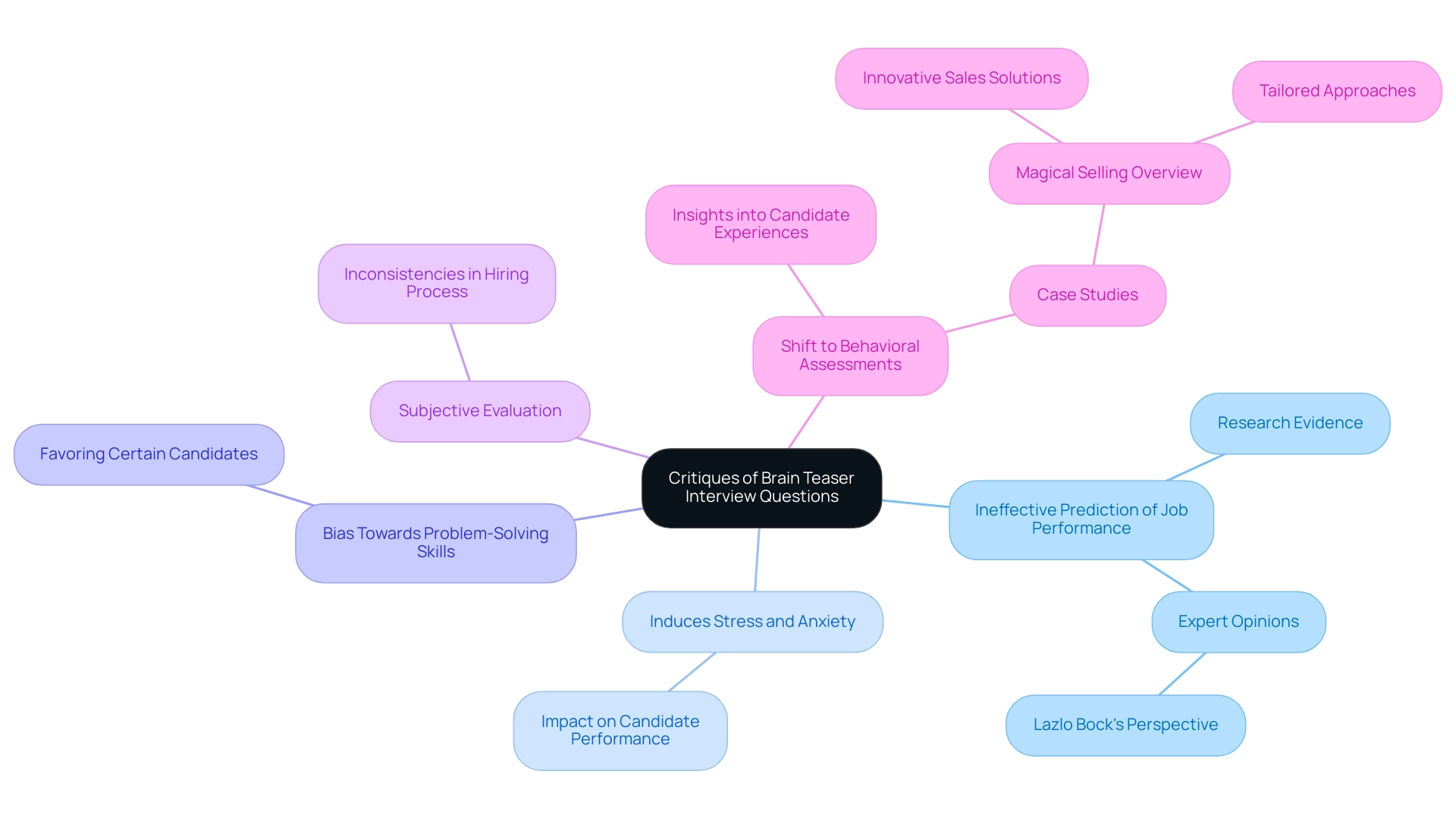
The inclusion of brain teasers in interview discussions significantly impacts the psychological environment for both applicants and evaluators. For candidates, these challenging questions often trigger heightened levels of stress and anxiety, hindering their cognitive clarity and overall performance. Research indicates that such stress reactions can lead to negative experiences, ultimately shaping their perception of the organization.
Conversely, recruiters may employ thought-provoking questions as a tactic to assert control during assessments, potentially revealing their own uncertainties or a desire to display intellectual dominance.
Understanding these intricate dynamics is essential for both parties involved. Candidates can benefit from preparing for the psychological challenges presented by puzzles, while interviewers might consider adopting a more compassionate approach to foster a supportive atmosphere. This shift can enhance the overall assessment experience, yielding more favorable outcomes for both applicants and employers.
Recent data from 2025 underscores that interview stress levels are considerably influenced by the nature of challenging questions, with applicants reporting increased anxiety when faced with particularly complex puzzles. Expert opinions suggest that while brain teasers can effectively assess problem-solving abilities, one must not overlook their psychological ramifications. For instance, individuals frequently feel that their performance on these questions reflects their overall suitability for the role, which can intensify stress levels.
This aligns with findings suggesting that sadism correlates with a greater appetite for cruelty, indicating that some interviewers may derive satisfaction from the stress they inflict on applicants.
Furthermore, case studies reveal that applicants encountering mental challenges during interviews often express feelings of inadequacy, particularly when they struggle to provide satisfactory answers. As Ernie Maschner, Vice President - Global Water at Victaulic, remarked, "When I would hire a construction estimator, I liked to ask, 'how many miniature golf pencils are in the US?'" This illustrates a pragmatic viewpoint on utilizing brain teasers in hiring, highlighting the necessity for a balanced strategy that considers the psychological consequences of such inquiries.
Moreover, an examination of data assessing focus and stress levels among individuals supports assertions regarding the influence of puzzles on participants' stress and performance. Consequently, a balanced approach that acknowledges the psychological effects of puzzles can lead to more productive interactions, ultimately benefiting both applicants and companies in the recruitment process. Additionally, referencing the 6D Selling Framework, which equips clients with essential tools for excelling in sales, can draw parallels between structured frameworks in interviews and the psychological effects of brain teasers, thereby enriching the discourse on interview dynamics.

The role of brain teasers in job interviews is multifaceted, serving as a tool for employers to assess candidates' critical thinking, creativity, and adaptability under pressure. These unconventional questions not only streamline the interview process but also provide insights into candidates' problem-solving strategies and communication skills. While brain teasers can reveal a candidate's analytical capabilities, they are not without their critiques. The subjective nature of these questions can lead to inconsistencies in evaluating responses, and concerns about inducing stress and anxiety have prompted many organizations to reconsider their use.
As the hiring landscape evolves, the effectiveness of brain teasers is increasingly questioned, with a shift towards structured behavioral interviews that align more closely with job competencies. Despite their historical popularity, the psychological impact of brain teasers on candidates cannot be overlooked, as they often trigger heightened stress levels that can hinder performance. This highlights the need for interviewers to adopt a more empathetic approach, fostering a supportive environment that enhances the overall experience for both parties.
Ultimately, while brain teasers can be a valuable addition to the interview process, organizations must balance their use with a focus on relevant skills and experiences. By doing so, they can create a more effective hiring strategy that not only identifies top talent but also promotes a positive and constructive interview experience. As the recruitment landscape continues to evolve, the integration of diverse assessment methods will be key to identifying candidates who can thrive in complex work environments.
What are brain teasers used for in job interviews?
Brain teasers are used in job interviews to assess applicants' critical thinking, creativity, problem-solving strategies, and their ability to articulate their thought processes under pressure.
Why are employers incorporating brain teasers into the interview process?
Employers incorporate brain teasers to evaluate candidates' analytical skills and adaptability, as well as to differentiate between applicants with similar qualifications but varying cognitive abilities.
What percentage of job applicants express concerns about lengthy evaluation processes?
Approximately 33% of job applicants express concerns about lengthy evaluation processes.
How do brain teasers benefit the hiring process?
Brain teasers help optimize the selection process by providing insights into an applicant's analytical capabilities and communication skills, which are essential in complex work environments.
What do recent studies indicate about the effectiveness of brain teasers?
While there is ongoing debate regarding their effectiveness, a significant percentage of employers continue to favor brain teasers to elicit unconventional responses from candidates.
How do candidates demonstrate their skills when faced with brain teasers?
Candidates demonstrate their skills by dissecting problems, thinking aloud, and showcasing their reasoning capabilities as well as their proficiency in conveying complex concepts effectively.
What differences have been noted in how male and female participants view brain teasers?
Male participants rated puzzle questions with an average score of 2.44, while female participants assigned them a score of 1.99, indicating differing perspectives on their utility.
What role do brain teasers play in the initial versus subsequent interviews?
In the initial interview, brain teasers primarily evaluate analytical skills, while subsequent interviews may focus on broader personality traits and decision-making processes.
What is the outlook for the use of brain teasers in interviews by 2025?
The trend of incorporating mental challenges, such as brain teasers, into assessments is expected to continue growing, reflecting a shift towards more dynamic evaluation methods.


