

Academy sales refer to structured training programs designed to enhance the skills and knowledge of sales professionals, particularly in competitive sectors like hospitality. The article emphasizes that these programs, which incorporate various methodologies and technology, are essential for improving sales performance, employee engagement, and customer retention, as they equip teams with the necessary tools to navigate market challenges effectively.
In the competitive landscape of modern sales, the importance of structured training programs cannot be overstated. Sales academies have emerged as vital resources for equipping professionals with the skills and knowledge necessary to excel, particularly in dynamic sectors like hospitality. These academies not only foster essential techniques but also promote a culture of continuous improvement, ensuring that sales teams remain agile and effective in the face of evolving market demands.
With the integration of innovative methodologies and advanced technologies, organizations are now better positioned to enhance employee engagement, improve customer relationships, and ultimately drive revenue growth. As the global market continues to expand, understanding the nuances of effective sales training becomes crucial for businesses aiming to thrive in this ever-changing environment.
Academy sales serve as a crucial component in the development of sales experts, functioning as organized programs designed to enhance their skills and knowledge. In an increasingly competitive marketplace, the academy sales programs provide sales teams with essential tools and strategies for success, particularly in sectors like hospitality where rapid client acquisition and effective go-to-market (GTM) strategies are vital. The incorporation of transformative Sales-as-a-Service solutions by Pods Asia showcases how customized instruction can equip teams to navigate market competition and address challenges in quota management and talent acquisition.
Typically, academy sales incorporate various training methodologies, including:
This fosters a rich learning environment. The importance of academy sales is emphasized by recent findings, which indicate that 80% of personnel believe that upskilling and coaching are key to improving job satisfaction. This not only improves individual performance but also aligns team members with the organization’s overarching business plans and objectives, essential for effective partner enablement.
Such alignment is crucial, as demonstrated by the fact that 78% of consumers are more inclined to repurchase from companies that emphasize personalization, highlighting how tailored approaches can lead to customer acquisition and retention. Business academies play a vital role in preparing sales experts for academy sales, which helps in embracing tailored strategies and ultimately improving customer relationships. Additionally, with the global door-to-door market estimated at $200.14 billion in 2022 and expected to expand at 6.4% each year until 2030, the demand for efficient programs in academy sales education is more urgent than ever.
As we look toward 2025, combining traditional marketing techniques with digital methods will be essential. Pods Asia’s established techniques for transforming sales processes, including:
These can equip teams for this changing environment, emphasizing the significance of structured instructional approaches in enhancing performance and reaching organizational objectives. For example, a case analysis on field sales efficiency indicates that investing in relationship-centered representatives and practical instruction greatly improves the efficacy of marketing strategies, showcasing the concrete advantages of well-organized sales development initiatives.

Training initiatives in academy sales offer numerous benefits that can significantly enhance the performance of sales groups. A pivotal benefit is the enhancement of product knowledge, which empowers sales professionals to articulate the features and benefits of their offerings with confidence. Moreover, these programs focus on academy sales by refining essential selling techniques and equipping individuals with skills in negotiation, objection handling, and closing strategies.
The impact of comprehensive development extends beyond mere performance metrics; it fosters increased employee engagement and retention. Data shows that almost 47% of account executives have left their roles due to insufficient preparation or inadequate onboarding experiences, highlighting the significance of investing in professional development. A case study titled 'High Turnover Due to Insufficient Preparation' reveals that nearly half of account executives attribute their departure to such deficiencies, indicating a significant cost associated with inadequate preparation.
Organizations that emphasize efficient development frequently see considerable increases in productivity, akin to the outcomes observed in academy sales, with employees feeling more appreciated and involved in their roles. This dedication to development also correlates with higher customer satisfaction and ultimately leads to enhanced academy sales. Moreover, since achieving success in 2025 will necessitate combining analog and digital approaches, efficient development programs must adjust to these changing techniques.
As recent statistics indicate, 34% of prospects enroll in email campaigns for special offers, while 29% look for discounts, emphasizing the significance of preparation in adjusting to current market demands and customer behaviors. As Mary Clare Novak aptly notes, 'By downloading this guide, you are also subscribing to the weekly G2 Tea newsletter to receive marketing news and trends.' This illustrates the ongoing development of marketing tactics, emphasizing the need for teams to consistently adjust and enhance through strong skill-building initiatives.
Furthermore, with the 'Net Neutral Account – Module 7' priced at $150/month, which includes access to tailored audio podcast sessions and three consultation sessions per month, potential customers can recognize the value in investing in such comprehensive education. Testimonials from former participants underscore the transformative effect of the program, highlighting its role in improving skills and overall performance.

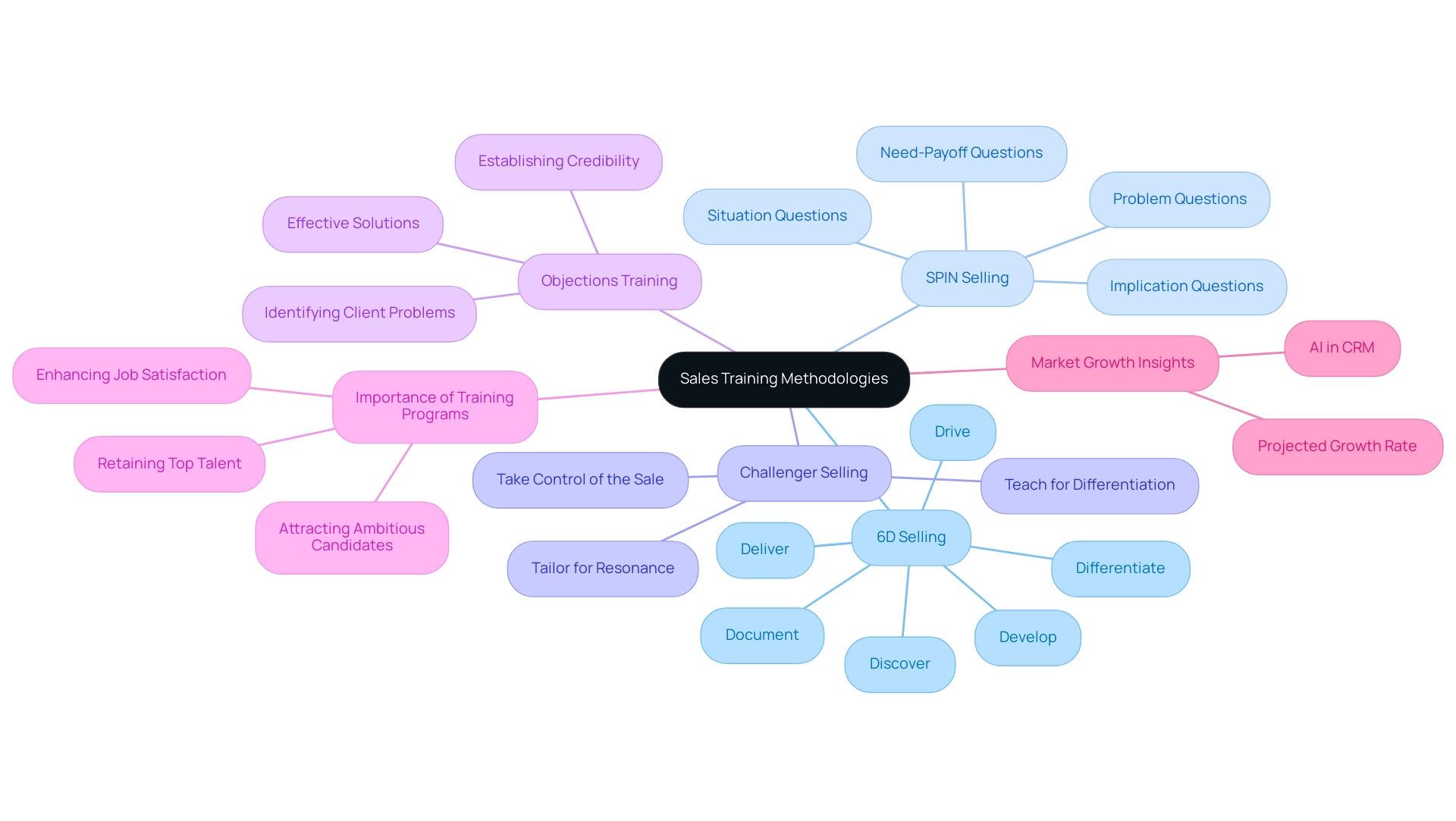
Training methodologies encompass a diverse range of approaches, each tailored to enhance skill development among teams engaged in academy sales. A prominent methodology is the '6D Selling' approach, which focuses on six essential dimensions: Discover, Develop, Deliver, Drive, Differentiate, and Document. This framework encourages sales professionals to cultivate a holistic perspective during client interactions, emphasizing the importance of nurturing long-term relationships rather than solely pursuing immediate transactions.
An essential principle within consultative selling is to sell the problem first before presenting the solution, establishing credibility in the process. Complementing this approach are methodologies like SPIN Selling, which prioritizes understanding customer needs through a structured process of Situation, Problem, Implication, and Need-Payoff questions, and Challenger Selling, which enables teams to educate customers with insights that inspire purchasing decisions.
Moreover, enhancing sales skills through credible objections training—such as that covered in Module 12—addresses core competencies in consultative selling. This training not only establishes credibility but also focuses on effectively identifying and solving client problems. The significance of mastering these dynamics is further amplified by strategies for winning against direct competitors.
Understanding whether you are the Disrupter or the Disrupted can shape a sales approach that effectively navigates competitive landscapes, incorporating best practices for execution against both regional and global players.
The importance of effective preparation and onboarding programs for academy sales cannot be overstated; they are crucial for enhancing job satisfaction and retaining top talent. In fact, 62% of college graduates prioritize opportunities related to academy sales that offer extensive development, highlighting that organizations with robust instructional methodologies are more likely to attract ambitious candidates. As Salesforce indicates, customers generally rely on a company to make truthful assertions regarding its products and services, highlighting the significance of well-prepared teams in fostering that trust.
In a market expected to expand at an annual rate of 6.4% until 2030, organizations that invest in efficient educational initiatives are more suitably equipped to adjust to changing market needs. Moreover, with 88% of revenue leaders expecting that artificial intelligence will improve their CRM methods within the next two years, incorporating modern technologies into instructional approaches is becoming increasingly vital. By analyzing these varied approaches and aligning development initiatives with particular marketing tactics and goals, organizations can greatly enhance their performance and overall efficiency.
Technology is transforming contemporary academy sales education, effectively shifting conventional methods into dynamic and engaging experiences. The implementation of Learning Management Systems (LMS) has become routine, with 63% of highly effective organizations employing these platforms to provide customized development programs that improve academy sales by tackling pressing challenges like quota management and market competition. Additionally, sophisticated instruments such as virtual reality (VR) and augmented reality (AR) are progressively utilized to create engaging environments that simulate real-world commercial situations.
These innovations not only enhance the learning experience but also enable academy sales teams through customized development pathways guided by individual performance metrics. In fact, 78% of customers are more likely to repurchase from a company that focuses on personalization, underscoring the importance of adapting educational approaches to meet specific organizational needs. Furthermore, the magic Sales Methodology offers an organized framework for commercial transformation, featuring compatibility assessments tailored for different academy sales roles, guaranteeing that instruction is pertinent and efficient.
The Sales-Map™ evaluation provided by Magical Selling enhances this method by offering focused development and objective measurement of proficiency, further boosting educational effectiveness and leadership insights. The essential requirement for strong development initiatives is further highlighted by a case study showing that almost half of account executives credit their exit from companies to insufficient preparation or onboarding in their academy sales programs. Adopting these technological innovations enables organizations to guarantee that their initiatives for academy sales development are not only efficient but also scalable and adaptable to the changing market environment, thereby retaining top talent and enhancing overall performance.
For organizations seeking to address these challenges, we encourage you to reach out for support in implementing tailored solutions that drive results.

Ongoing enhancement is crucial for the success of academy sales initiatives in today’s fast-moving business landscape. As new technologies and shifting consumer behaviors emerge, organizations must embrace a culture of ongoing development. Statistics reveal that representatives who engage in effective practice opportunities are more likely to meet their targets, with 57% achieving 75% or greater of their objectives.
Moreover, top performers are:
This emphasizes the need for ongoing enhancement in instructional methodologies. This is where Magical Selling's downloadable educational packages come into play, offering strategies that enhance credibility and account growth through solution selling. Explore our variety of downloadable packages, priced competitively to provide maximum value, and discover how they can transform your approach to selling.
The success of Pods Asia's transformative sales-as-a-service solutions, exemplified by winning 17 new logos in South East Asia within just two quarters, highlights the effectiveness of academy sales in rapidly acquiring clients and expanding market presence. Establishing organized feedback cycles enables sales groups to offer insights on the efficacy of their development, identifying areas for improvement. Furthermore, employing performance metrics such as:
allows organizations to assess the tangible effect of education on revenue outcomes, enabling data-driven adjustments to development programs.
The importance of continuous improvement is echoed by Lorman Education Services, which notes that 87% of millennials consider learning and development crucial in the workplace. Additionally, a SHRM report indicates that investing in continuous development not only enhances employee performance and engagement but also significantly reduces recruitment costs by cultivating existing talent to fill internal positions. By promoting a culture of continuous improvement, companies can ensure their academy sales teams remain agile, knowledgeable, and well-equipped to meet market demands.
Recognizing the target group for educational programs is essential to guarantee that initiatives are both pertinent and impactful. The main audience generally includes professionals in commerce at varying levels, from newcomers to seasoned executives. Each group has unique needs and challenges; for example, new sales representatives often need basic instruction on product knowledge and vital selling techniques, while seasoned executives gain from advanced strategies and leadership development that can improve their performance.
Identifying particular challenges encountered by business development teams—such as maneuvering through complex transaction cycles, handling stakeholder connections, and tackling the skills gap in questioning potential clients—is crucial for tailoring educational initiatives. Significantly, data shows that 68% of representatives lack the essential understanding to effectively investigate and inquire about potential clients, highlighting the need for focused development. Moreover, a notable 75% of organizations have organized initiatives in academy sales development aimed at upskilling or reskilling their employees, as emphasized by Aayushi Sanghavi, Campaign Coordinator at G2.
With 62% of college graduates prioritizing opportunities that provide extensive training, the quality of training programs is becoming a key factor in recruitment. Innovative solutions, such as discovery workshops, can help uncover the kryptonite of academy sales groups, thereby unlocking their potential and enhancing performance. These workshops have demonstrated an increase in team effectiveness by up to 30%, contributing to improved academy sales through enhanced conversion rates and client engagement.
The flexibility of training material, as shown in the Door-to-Door Sales Resilience case study—where effective approaches merge high-volume prospecting with adaptable pitches—demonstrates how organizations can enhance the effectiveness of their training initiatives by aligning content with the audience's specific needs. In the case study of the engineering services company, implementing a structured approach to deal creation and account management led to a 5% market share growth, showcasing how tailored strategies can compete effectively with global cloud providers. This approach not only boosts conversion rates but also fosters client loyalty, essential for thriving in competitive markets, as showcased by Pods Asia's successful sales transformation efforts that have led to a remarkable 28% revenue growth.

Structured sales training programs, particularly through sales academies, provide essential benefits that empower sales teams to thrive in an increasingly competitive marketplace. These academies not only enhance product knowledge and selling techniques but also foster employee engagement and retention. The importance of investing in comprehensive training is underscored by the significant turnover rates attributed to inadequate support, emphasizing that organizations prioritizing professional development are likely to see improved sales productivity and customer satisfaction.
Moreover, the integration of diverse methodologies, such as consultative selling and technology-driven approaches, further refines the training process. By embracing continuous improvement and leveraging innovative tools, such as Learning Management Systems and immersive technologies, organizations can adapt their training to meet the evolving demands of the market. The emphasis on personalized training pathways ensures that sales professionals are equipped with the skills necessary to build strong customer relationships and drive revenue growth.
Ultimately, understanding the target audience for sales training is crucial for tailoring programs that address specific needs and challenges. By aligning training initiatives with the unique characteristics of different sales roles, companies can significantly enhance their effectiveness and market presence. As the landscape continues to evolve, the commitment to structured sales training will remain a vital component in achieving organizational goals and sustaining competitive advantage.
What are academy sales and their purpose?
Academy sales are organized programs designed to enhance the skills and knowledge of sales experts, providing them with essential tools and strategies for success in competitive marketplaces, particularly in sectors like hospitality.
What training methodologies are typically incorporated in academy sales?
Academy sales typically include various training methodologies such as interactive workshops, role-playing exercises, and e-learning modules to create a rich learning environment.
Why are upskilling and coaching important in sales?
Upskilling and coaching are considered key to improving job satisfaction, with 80% of personnel believing that these initiatives enhance individual performance and align team members with the organization’s business objectives.
How does personalization impact customer retention?
Personalization is crucial for customer retention, as 78% of consumers are more likely to repurchase from companies that emphasize tailored approaches, which can lead to better customer acquisition and retention.
What is the significance of business academies in sales training?
Business academies prepare sales experts for academy sales, helping them embrace tailored strategies that ultimately improve customer relationships.
What is the projected growth of the global door-to-door market?
The global door-to-door market was estimated at $200.14 billion in 2022 and is expected to expand at a rate of 6.4% each year until 2030, indicating a growing demand for efficient academy sales education programs.
What techniques does Pods Asia use to transform sales processes?
Pods Asia employs techniques such as real-time performance insights, customized coaching, and organized frameworks like the Heart of the Deal Method and Deal Discovery Frameworks to enhance sales processes.
What benefits do training initiatives in academy sales provide?
Training initiatives in academy sales enhance product knowledge, refine selling techniques, and equip individuals with negotiation, objection handling, and closing strategies, leading to improved performance and higher employee engagement.
What is the impact of insufficient preparation on sales personnel?
Almost 47% of account executives have left their roles due to insufficient preparation or inadequate onboarding, highlighting the importance of investing in professional development to reduce turnover.
How do efficient development programs affect customer satisfaction?
Organizations that focus on efficient development often see increased productivity and higher customer satisfaction, which ultimately leads to enhanced academy sales.
What is the cost of the 'Net Neutral Account – Module 7' and what does it include?
The 'Net Neutral Account – Module 7' is priced at $150/month and includes access to tailored audio podcast sessions and three consultation sessions per month.
What do testimonials from former participants indicate about academy sales programs?
Testimonials from former participants emphasize the transformative effect of academy sales programs, highlighting their role in improving skills and overall performance.


